
First published: March 17, 2026
Last updated: March 25, 2026
The extent of the destruction is evident in the Gaza Strip, where thousands of children have been killed in relentless bombardment. Similar dangers persist elsewhere, with attacks on schools and civilian areas placing children directly in harm’s way.
Recent events, including a reported missile strike on a primary school in Minab in southern Iran, reported attacks on a school and kindergarten complex in Sudan, and casualties involving children in Lebanon, highlight how innocent lives are increasingly being caught in the crossfire of modern conflicts.
Humanitarian agencies said violence affecting children has also been reported in Afghanistan, Myanmar, Ukraine, Kuwait and Israel, highlighting the widening human cost of wars across several regions.
UNICEF Deputy Executive Director Ted Chaiban said on March 23, 2026, that more than 2,100 children have been killed or injured in the intensifying Middle East conflict since February 28, expressing grave concern over the mounting toll. The figures include 206 children reported killed in Iran, 118 in Lebanon, four in Israel and one in Kuwait. The agency warned that the numbers could rise as the violence continues to spread.
He said that in the 23 days of fighting so far, children across the region have paid a heavy price, and warned that a prolonged or wider conflict would be disastrous for millions.
In Iran, up to 3.2 million people are estimated to have been displaced, including about 864,000 children, according to U.N. refugee agency (UNHCR).
A strike hit Shajareh Tayyebeh Girls’ Primary School in Minab, on February 28, 2026, during the first day of U.S. and Israeli attacks on Iran. Reports said 278 people were killed or injured in the incident, including students and school staff.
Iranian authorities held the United States and Israel responsible for the deadly strike on the Shajareh Tayyebeh school. Neither country has claimed responsibility, while Washington said it was investigating the incident.
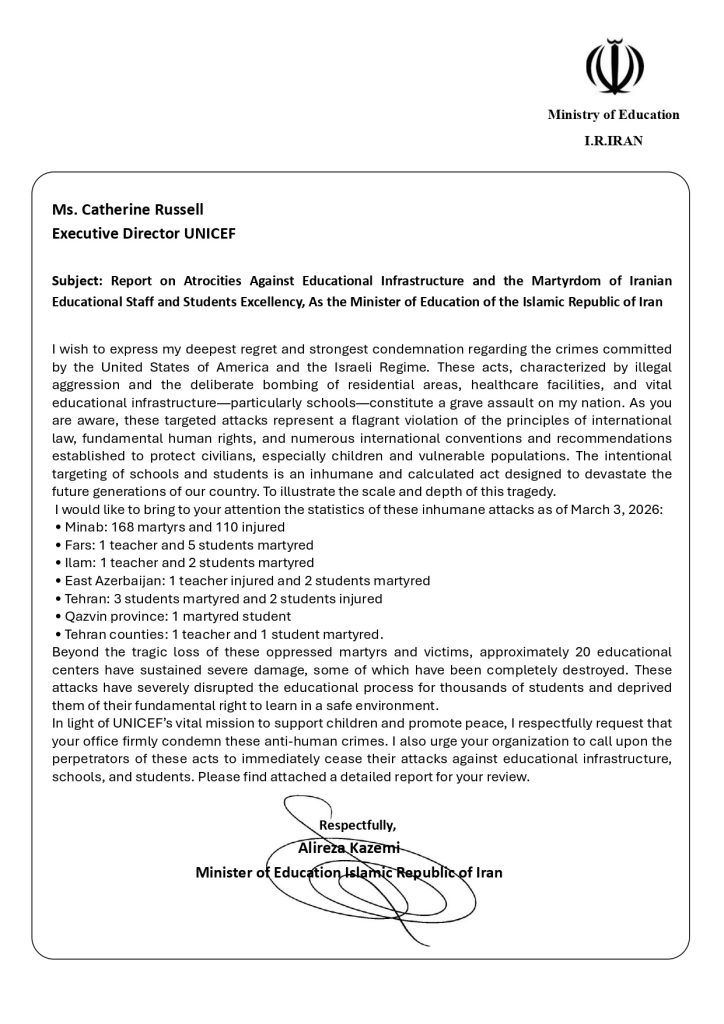
Iran’s Education Minister Alireza Kazemi submitted a report to international bodies, including UNICEF and UNESCO, presenting data up to March 3 on casualties among students and teachers, and alleging that “inhumane attacks” by the United States and Israel had targeted educational infrastructure in Iran. He strongly condemned what he described as “crimes” committed by the United States and Israel.
Iran’s Education Ministry described the students and educational staff killed in the strikes as “martyrs.” The ministry’s report stated: “In Minab, 168 were martyred and 110 injured; in Fars Province, one teacher and five students were martyred; in Ilam, one teacher and two students were martyred; in East Azerbaijan, one teacher was injured and two students were martyred; in Tehran, three students were martyred and two students injured; in Qazvin Province, one student was martyred; and in Tehran counties, one teacher and one student were martyred.”
The figures continue to rise in Lebanon. Ministry of Public Health, in its report dated March 23, 2026, stated that 118 children have been killed and 380 wounded in Israeli attacks on Lebanon since March 2.
In Lebanon, more than 1 million people have been displaced, including an estimated 370,000 children (nearly one-third of the total), with many families sheltering in public buildings, including schools, UNICEF said.
Meanwhile, children in Sudan have also been affected by attacks on schools and civilian infrastructure amid the ongoing conflict in the country. In a fresh incident in Sudan, the World Health Organization has verified that Al Deain Teaching Hospital in East Darfur was struck, killing at least 64 people, including 13 children. The attack on Al Deain Teaching Hospital took place on March 20, 2026, and was later confirmed by the WHO.
UNICEF on March 13 said that at least eight students and a health worker were reportedly killed when reported drone strikes hit a school compound and a healthcare centre in Shukairi village in White Nile State, Sudan. Earlier incidents included a drone strike on a displacement camp in Al Sunut, West Kordofan (Sudan) that reportedly killed at least 15 children and 10 wounded in February 2026. Another attack in South Kordofan (Sudan) in December 2025 targeted a kindergarten, where more than 10 children aged between five and seven were reportedly killed, according to a UNICEF report.
Children have been among the worst affected in the Gaza Strip, with reports indicating a large number killed in Israeli attacks and widespread damage to educational infrastructure. The UN agency UNRWA said in February 2026 that nearly 90 percent of all school buildings in Gaza have been damaged or destroyed during the war. Many of the remaining school buildings have been turned into shelters for displaced families, while children continue learning in temporary spaces or through digital programmes run by UNRWA teams.
In a report issued in March 2025, UNICEF stated: “After nearly 18 months of war, more than 15,000 children have reportedly been killed, over 34,000 reportedly injured, and nearly one million children repeatedly displaced and deprived of their right to basic services in Gaza Strip.” Conflicts have also left thousands of children without parental care. In 2024, UNICEF estimated that at least 17,000 children in the Gaza Strip were unaccompanied or separated from their parents, underscoring the long-term humanitarian consequences of armed conflict on children and their communities
In Ukraine, the war with Russia has significantly affected children, with reports of casualties, displacement, and disruption to education. According to UNICEF’s report, bombardments and long-range strikes have killed or injured more than 3,200 children in Ukraine since February 2022. The agency said more than 2.5 million Ukrainian children remain displaced, including hundreds of thousands inside the country and many living as refugees abroad. “More than 1,700 schools and other educational facilities have been damaged or destroyed, leaving roughly one in three children unable to attend full-time in-person classes.”
Reports have also emerged of children falling victim to such attacks in Myanmar. In a statement released in February 2026, UNICEF said it was deeply alarmed by reports that at least five children were killed and three others injured in airstrikes in parts of Myanmar.
Amid the conflict between Pakistan and Afghanistan, UNAMA (United Nations Assistance Mission in Afghanistan) on March 13 reported that at least four civilians were killed and 14 others injured, including women and children, in airstrikes in the Pul-e-Charkhi area of Kabul, Afghanistan.
Israel’s Foreign Ministry said in a March 23, 2026 letter to UNICEF that “indiscriminate” Iranian ballistic missile attacks resulted in casualties among civilians and children, who it said were the primary victims. According to the letter, at least four children were killed and 18 children injured in multiple strikes across several locations in Israel. The ministry alleged the use of cluster munitions by Iran and highlighted both physical and psychological harm to children.
Nina Ben-Ami, Deputy Director General for UN and International Organizations at the Ministry of Foreign Affairs of Israel said that an Iranian ballistic missile equipped with cluster munitions struck the city of Rishon LeZion on March 21, scattering submunitions across 11 locations, including a kindergarten and daycare complex which was fortunately empty at the time.
Ben-Ami further said that on March 21, a missile strike in Arad led to the evacuation of over 115 civilians, with eighteen children among those wounded, including a 5-year-old in critical condition, while four other children remain in intensive care. She added that earlier strikes in Dimona injured around 60 civilians, including children, and that children were also wounded in incidents in Eilat and Beersheba. She further said that a March 1 missile strike in Beit Shemesh killed nine civilians, including four children, and injured over 50, while rescue teams pulled dozens of children from the rubble, including an infant and a 10-year-old girl in serious condition. She urged UNICEF to issue an immediate and explicit public condemnation of Iran.
Humanitarian organisations warn that attacks on schools and civilian infrastructure are devastating the lives of children growing up amid violence, displacement and disrupted education. Echoing concerns, Tedros Adhanom Ghebreyesus, Director-General of the World Health Organization, said attacks on hospitals and schools must be called what they are: war crimes.
“Bombing a hospital or a school isn’t a ‘miscalculation.’ Killing a paramedic isn’t ‘collateral damage.’ Starving civilians isn’t a ‘negotiating tactic.’ These are war crimes. Full stop. Call it what it is,” said Dr Tedros in a post on X.
Reports of attacks on schools, health facilities, homes and displacement camps have raised questions about accountability under international law.
Last updated on March 25 : This article has been updated with additional details.
